
If you’re building a low-energy home, your foundation choice can affect far more than the structural performance of the building. It can influence heat loss, construction costs, build complexity and, ultimately, how easy it is to achieve the energy standards you’re aiming for.
Many self-builders start by assuming traditional strip foundations are the obvious choice because they’re familiar. The reality is that once low-energy performance enters the equation, the conversation changes.
The Short Answer
If you’re building a standard home, strip foundations may be perfectly suitable.
If you’re aiming for Passivhaus standards or a genuinely low-energy home, a Passive Slab will usually provide a simpler route to achieving the thermal performance you’re looking for.
What Are Traditional Strip Foundations?
Strip foundations have been the go-to choice for residential construction in the UK for generations. Concrete is poured beneath the load-bearing walls, with the floor structure built separately afterwards.
There’s nothing inherently wrong with that approach. In fact, strip foundations remain a sensible solution for many projects and are familiar to most contractors.
The challenge comes when you’re trying to build a highly insulated home.
To achieve good thermal performance and reduce thermal bridging, insulation needs to be incorporated into the floor build-up and carefully detailed around the junction where the floor meets the external walls. It’s entirely possible to achieve excellent results, but it relies heavily on design, workmanship and attention to detail on site.
That’s often where thermal bridging issues arise.
What Is a Passive Slab?
A Passive Slab, also known as an insulated raft foundation, takes a different approach.
Rather than treating the foundation, floor slab and insulation as separate elements, they’re designed as a single system. The slab sits within a highly insulated envelope, creating a continuous layer of insulation around the concrete floor slab.
For projects targeting Passivhaus standards or low-energy performance, that integrated design can simplify a lot of the detailing that would otherwise be required with more traditional foundation systems.
It doesn’t automatically guarantee a better building, but it does make it easier to achieve the levels of thermal performance many projects are aiming for.
Thermal Performance and Heat Loss
This is usually where the decision is made.
For a standard new-build, strip foundations can perform perfectly well when detailed correctly. However, as insulation standards increase and heating demand targets become more ambitious, the floor-to-wall junction becomes one of the most important areas of the entire building.
Even relatively small thermal bridges can undermine the performance of an otherwise well-insulated home.
With traditional strip foundations, achieving excellent thermal performance often relies on careful detailing and installation on site. It can be done, but there are more junctions to consider and more opportunities for heat loss if those details aren’t executed correctly.
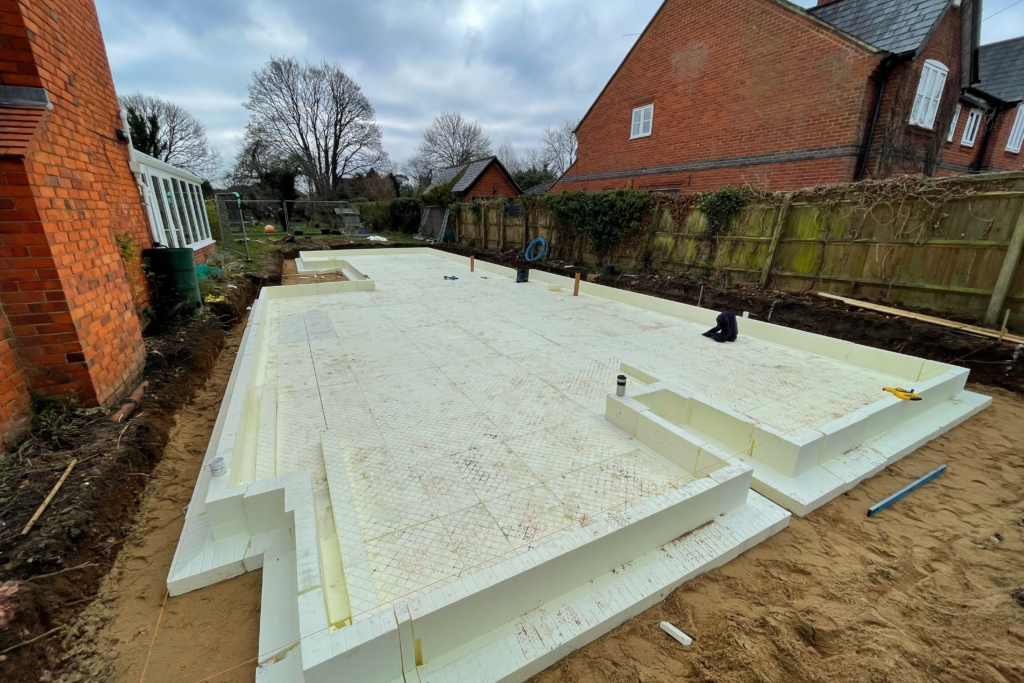
A Passive Slab approaches the problem differently. The continuous insulation beneath and around the slab is designed to minimise thermal bridging from the outset, creating a simpler route to achieving the levels of performance typically associated with low-energy and Passivhaus construction.
For many self-builders, that’s one of the biggest advantages. Rather than trying to manage thermal bridges later, the foundation system is designed to address them from day one.
Installation and Construction Programme
The practical side of construction is often overlooked when comparing foundation systems.
A Passive Slab combines several construction stages into one process. The foundation, insulation and slab are installed as part of an integrated system, reducing the number of separate elements that need to be coordinated on site.
Traditional strip foundations generally involve additional excavation, foundation work, blockwork and floor construction before the finished floor is ready.
Every project is different, but a simpler sequence can often mean fewer opportunities for delays, misunderstandings and costly remedial work.
Cost: It’s Not Always as Clear-Cut as People Think
One of the most common assumptions is that Passive Slabs are significantly more expensive than traditional strip foundations.
The reality is a bit more nuanced.
The initial cost of an insulated raft foundation may be higher than a basic strip foundation package. However, comparing foundation costs in isolation rarely tells the whole story.
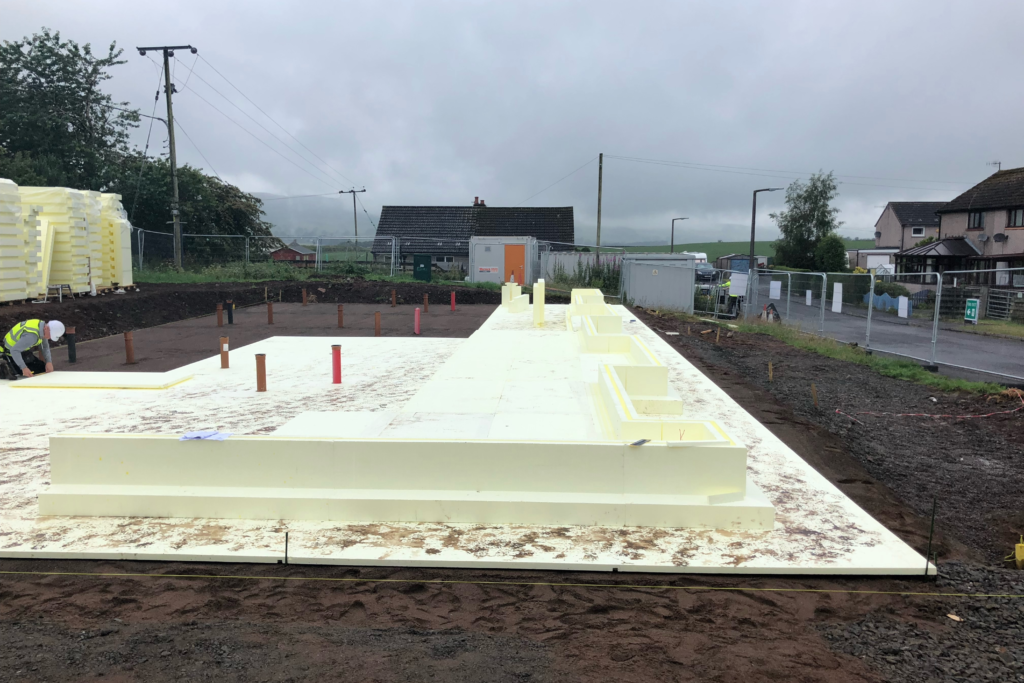
A Passive Slab incorporates structural elements, insulation and floor construction into a single system. While the upfront cost of an insulated raft foundation may be higher than some strip foundation solutions, the overall comparison should take account of labour, construction sequencing and the level of thermal performance required. The most cost-effective option will depend on the specifics of the project.
The right choice depends on the objectives of the project rather than simply the upfront cost.
Which System Makes More Sense for a Low-Energy Home?
Both systems can provide a structurally sound foundation. The question is whether they support the wider performance goals of the building.
If you’re constructing a conventional home, traditional strip foundations may be entirely appropriate. They’re familiar, widely used and suitable for many types of project.
For low-energy homes and Passivhaus projects, the priorities are often different. Reducing thermal bridging, improving airtightness and achieving demanding energy targets all become part of the design process.
This is where a Passive Slab comes into its own.
By combining the foundation, floor structure and insulation into a single system, it helps create a more thermally efficient building envelope while reducing the complexity of detailing required on site.
That doesn’t mean every project should use a Passive Slab. Ground conditions, design requirements and budget all need to be considered. However, for self-builders and developers aiming to maximise energy performance, it is often one of the most effective foundation solutions available.
The foundation is only one part of a low-energy home, but it influences everything that follows. Starting with a well-insulated, thermally efficient base can make it significantly easier to achieve the performance standards the rest of the project is working towards.